The Community Resilience to Foreign Interference Hub
Building a multilingual community safety hub, on a platform we'd never used
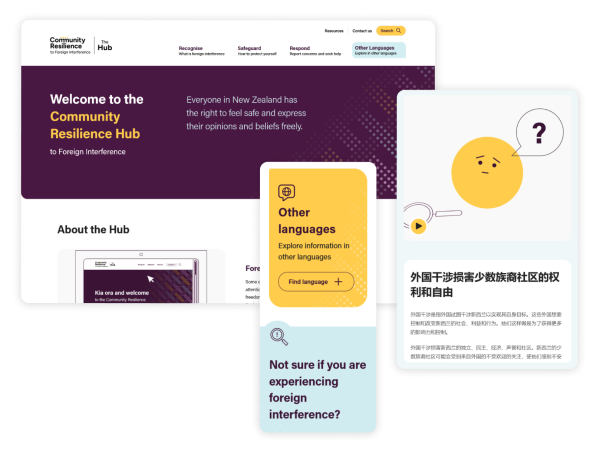
Between March and July 2026, Signify designed and built the Community Resilience to Foreign Interference Hub for the Ministry for Ethnic Communities (MEC). The project covered design, build, a multilingual content structure across 31 languages, content migration and loading, testing and launch. The site is now live at crfi.govt.nz, built on Squiz, a content platform that was new to Signify going into the project.
The challenge
MEC wanted a dedicated website to help ethnic communities, and the wider New Zealand public, recognise foreign interference, understand how to safeguard against it, and know how to respond and report concerns.
A number of resources were already available on MEC’s main site; however, a new stand-alone website was required with updated information architecture to align with the new three-part community resilience framework so that it was presented in a more engaging, intuitive, and easy-to-navigate way. Several new resources were also added to the site and needed to be integrated within this framework to ensure a consistent user experience.
The site needed to work across three core pillars (Recognise, Safeguard, and Respond), bring across a large amount of existing content, and support translated pathways into up to 31 languages, including translated video transcripts, totalling 548 pages. All of this had to come together on a tight timeline, from design sign-off through to launch.
 On top of that, the site had to be built on Squiz. Signify's website work up to that point had been built on Silverstripe, Drupal and Wagtail, not Squiz, so the team needed to get productive on a new platform fast, without that learning curve showing up in how the project felt to deliver.
Our approach
Two things had to happen at the same time: build real capability on Squiz and deliver the rest of the project at Signify's usual standard. Rather than treating the platform as something to work around, the team leaned on transferable CMS experience, template-based page building, content modelling, role and permission setup, and version control, to shortcut the learning curve and get to productive delivery quickly.
With that foundation in place, the team delivered:
- Design work aligned to MEC's brand and concepts, including wireframes for the home page and core landing pages.
- Page templates for the home page, four core section landing pages, a resource library, and dedicated landing pages for each translated language.
- Reusable content blocks and interactive elements, including accordions for managing translations, sidebars and call-to-action buttons.
- A translated content pathway supporting 31 languages, with translated video transcripts delivered alongside the videos.
- Migration of around 240 HTML pages, 340 PDFs and 340 DOCX files from the existing MEC site, with redesigned layouts for migrated HTML pages, plus roughly 100 new HTML pages built from existing PDF and DOCX resources for specific languages.
- A heavy content loading effort alongside the migration: uploading written resources and animated videos, building out the translated versions of each, and pairing translated transcripts with every video.
- Squiz CMS configuration, including user roles, version control, SEO, XML sitemaps and analytics tracking.
- Accessibility testing to WCAG standards, security and encryption implementation, and deployment across environments.
None of this happened in isolation. Getting up to speed on Squiz and hitting the mark on a sensitive, multilingual site meant working closely with the MEC team, Squiz, and DIA Business Technology Services throughout, from early design decisions through to launch.
The result
MEC now has a purpose-built, multilingual hub that gives ethnic communities and the wider public a clear, accessible way to engage with a sensitive topic. The site is live at crfi.govt.nz, with content structured across the Recognise, Safeguard and Respond sections and translated pathways into dozens of languages.
For Signify, the project also built a genuine new capability: the team can now deliver confidently on Squiz, alongside its existing Silverstripe, Drupal and Wagtail experience. That widens the range of government CMS platforms Signify can competitively bid and deliver on, rather than this being a one-off adaptation for a single client.